
Request a demo Login

Our Vision

Our Vision is to be the most student-centred, evidence-based Company in the field of Education and Special Education.

Esybee is committed to improving Teachers' effectiveness through Evidence-Based Practices, Professional Development and design instruction that accelerates and ameliorate Students' Learning process, that is more effective, personalised and aligned with opportunities brought by technology and the digital environment.

Mission Statement

Achieve Equity: Ensuring that with Esybee, every student will have the same opportunity to succeed, with a particular focus on closing the poverty-related learning environment and scaffolding them to succeed.

Achieve Excellent Results: Ensuring that every student achieves the highest standards in their learning, set out within Curriculum for Excellence levels, and the high range of skills, qualifications and achievements to allow them to succeed.

Learner stories · From classroom moments to insight

Every learner has a story.

Explore four short classroom stories to see how the right questions, teaching decisions and support can make learning more visible.

Sofia
Sofia

Sofia sees fractions in a new way.

One incorrect answer does not explain what the learner understands. Her teacher Anna investigates the reasoning behind it.

The challenge

Sofia writes ½ + ¼ = ²⁄₆.

The evidence

With fraction strips and prompting, Sofia can show that ½ = ²⁄₄, but does not yet connect this securely to symbolic notation.

Teacher response

Anna models equivalent fractions and asks Sofia to link visual representations to the matching symbols.

Next evidence

Recheck her independent explanation, retention and use of the idea in unfamiliar problems.
Malik
Malik

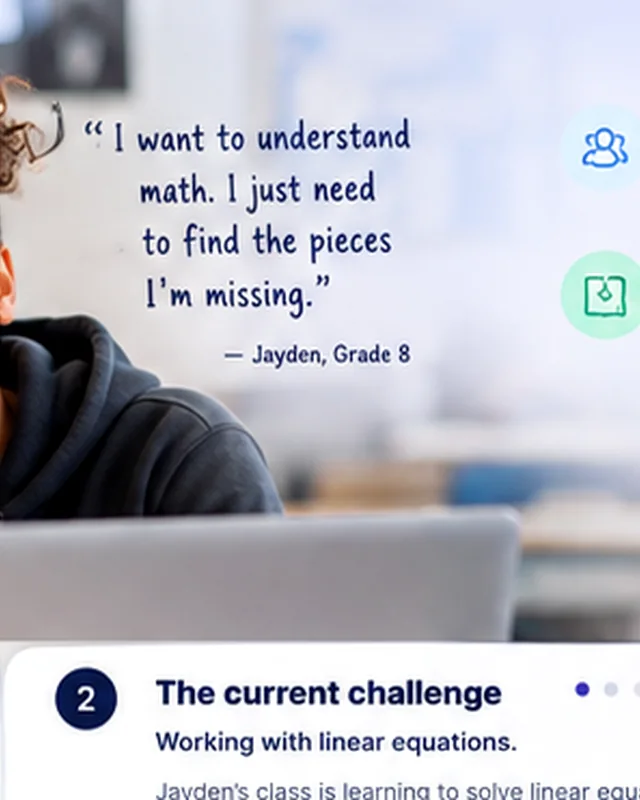
Malik finds the missing connection.

A complex Grade 8 equation becomes easier to investigate when teaching can be linked to the foundations it requires.

The challenge

Malik expands 4(2x − 3) as 8x − 3 rather than 8x − 12.

The evidence

The response suggests an issue with the distributive property; the teacher also checks relevant multiplicative and signed-number knowledge.

Teacher response

The teacher uses algebra tiles, equal groups and worked examples to test and strengthen the connection before returning to the equation.

Next evidence

Check whether Malik can solve and explain a parallel equation with less support and apply the reasoning in a new context.

Amina
Amina

Amina moves from procedures to meaning.

A capable learner can give fluent answers yet benefit from deeper conceptual connections and further challenge.

The challenge

Given a 2:3 red-to-blue ratio and 6 blue counters, Amina first proposes 5 red counters.

The evidence

Her explanation reveals additive rather than multiplicative reasoning in this task; this is a specific observation, not a general ability judgement.

Teacher response

Her teacher uses equal groups, scaling and a ratio table, then offers richer problems once the relationship is secure.

Next evidence

Ask Amina to justify the 4:6 equivalent ratio and apply scaling to an unfamiliar situation.

Mia
Mia

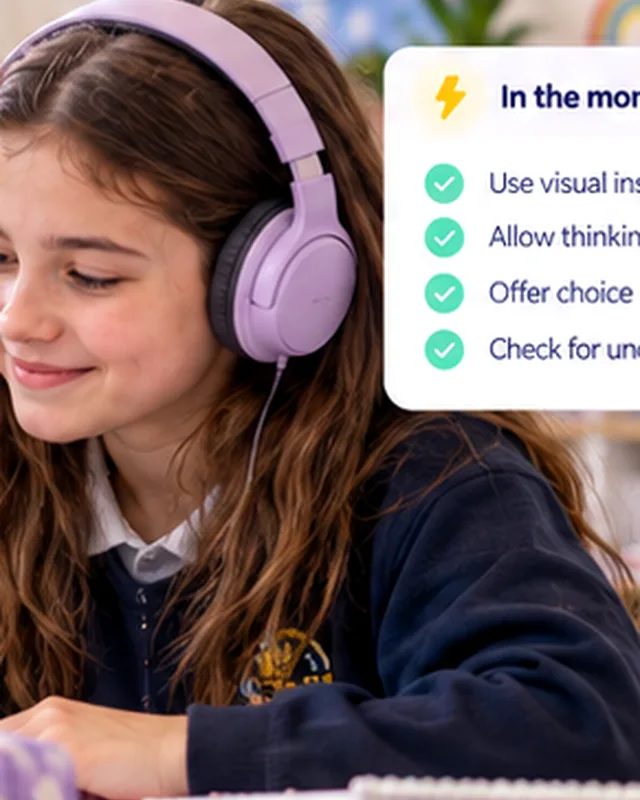
Mia explores science on her own terms.

A predictable environment and appropriate accommodations help a learner participate in the same ambitious science learning as her classmates.

The challenge

Mia understands scientific patterns but finds unstructured verbal instructions and noisy transitions difficult to navigate.

The evidence

The teacher documents strengths, access preferences, task conditions and what Mia demonstrates in different response formats.

Teacher response

With Mia’s input, Ms Carolina offers a visual sequence, a calmer work area, flexible explanation formats and an extended investigation.

Next evidence

Review conceptual reasoning, participation and increasing independence without removing useful access accommodations.

Our Team

Filomena von Zeipel
CVO & CO-Founder
Head of learning & Development, Special education and autism expert.
Lars von Zeipel
CEO & CO-Founder
Head of Administration.
Andrei Nonchev
Head of AI tech
Expert in machine learning development, developer of CRM & ERP systems.
Maya Kerezieva
Head of UX design and research.
Coordinator for Eastern Europe
Oluwakemi Olurinola
Researcher & Esybee`s Africa Coordinator
Head of Research & Development, in Digital Pedagogy
Dr. Iliya Kereziev
Business Analysis and Research Consultant

Frequently Asked Questions

What user roles does Esybee support? 

Esybee supports roles and specific tools for principals, teachers, special teachers, students and parents.

What is Esybee? 

Esybee AB is an education technology company and a leading modular, cloud-based Educational Management System for K-12th grade and universities students, developed by Esybee AB and VECTOR Labs.

What is Response to Intervention? 

Response to Intervention, or RTI, is an educational strategy used in schools to provide effective and high-quality instruction, monitor all students` progress and provide additional support (intervention) to students who are struggling.

What is Tao Testing? 

TAO is the first commercial-grade Open Source assessment development software on the market. It is QTI and LTI standards-based, and operates under audit-proof transparency. Developers can access the source code in order to create and administer their own tests, opening the user to a wide range of potential customizations. Complete ownership of test design has never been this easy; without the restrictions and high costs of proprietary testing, all assessments can easily be displayed with the educational institution’s signature details. Furthermore, TAO is fully compatible with just about all of your favorite commercial add-ons.

How to work with the PLOP evaluation tool? 

The present levels of performance (PLOP, also sometimes called PLAAFP or PLP) describe the child`s current abilities, strengths, and needs or challenges, and are a key component of progress reporting. Esybee provides an integrated tool for PLOP evaluation.

What is a National Curriculum 

A national curriculum is a common programme of study in schools that is designed to ensure nationwide uniformity of content and standards in education. It is usually legislated by the national government, possibly in consultation with state or other regional authorities.

How to work with Rubric assesments? 

A rubric is an assessment tool that clearly indicates achievement criteria across all the components of any kind of student work, from written to oral to visual. It can be used for marking assignments, class participation, or overall grades.

Are you looking for a
Learning Management System?

Get in touch